Monday, November 14, 2022

Mercedes-AMG E63 S (2021-)


The current Mercedes-AMG E63 S received a mid-cycle refresh for the 2021 model year. Spotting one of the most up-to-date AMG E63s out and about is a big deal to me since it is one of my dream cars. Powering the AMG E63 S is a 4.0-liter twin-turbo V8 producing 603 horsepower and 627 lb-ft of torque paired to a nine-speed automatic gearbox. It launches from zero to 60 mph in three seconds and is capable of a top speed of 186 mph. The mid-cycle refresh for 2021 consists of a new and larger grille, restyled headlights and taillights, new 20-inch wheels, a revised rear diffuser, a new steering wheel with bigger paddle shifters, an updated infotainment system, and an improved suspension. Pricing for the updated Mercedes-AMG E63 S starts at $108,550. The example featured here is the only current E63 that I've seen in person that has received the mid-cycle refresh. I would be freaking out even more if I spotted a wagon version of the current mid-cycle refresh AMG E63 S, especially since the wagon is way less common than the sedan and I have a fetish for fast wagons. Overall, I love the Mercedes-AMG E63 S, and it still remains my favorite super sedan and fast wagon. It is a perfect combination of speed and luxury and one of the best all-around cars.

Give the gift of CPF apparel this holiday season (sample pictured below): CPF Store


Wednesday, November 9, 2022

Mercedes-Benz G63 AMG 6x6


The legendary Mercedes-Benz G-Wagen is a super cool and amazing SUV, but this one is arguably the craziest one yet. Based on the previous-generation G-Class, the G63 AMG 6x6 gains a third axle, a pickup bed, larger wheels, and a significantly lifted suspension over the standard G63 AMG and most other G-Wagen models to tower over nearly all other vehicles on the road. Powering the G63 6x6 is a 5.5-liter twin-turbo AMG V8 producing 536 horsepower and 561 lb-ft of torque mated to a 7-speed automatic gearbox. It launches from zero to 60 mph in 7.8 seconds and carries a top speed limited to 100 mph; these performance stats are hampered due to the G63 6x6's sheer size and presence. Other distinctive features of the G63 6x6 include a stainless steel roll bar, LED lights above the windshield, five electronic differential locks, and a compressor that can increase or decrease tire pressure to gain better traction to any driving surface. For a greater idea of how huge the G63 AMG 6x6 is, it is roughly eight feet tall and 19 feet long, has roughly 18 inches of ground clearance, and weighs in at around 9,000 pounds. 

The G63 6x6's interior is very similar to that of nearly every previous-generation G-Wagen, except the 6x6 contains a unique center console in the rear seats. In total, only around 100 to 150 G63 6x6s were built from 2013 to 2015. It was never officially sold in the U.S. by Mercedes-Benz, but a few have made their way Stateside after being tweaked to meet federal regulations. Pricing for the G63 6x6 started at $600,000 when new but is now worth roughly $1.5 million or more. I have wanted to see a G63 6x6 up close and in person ever since it was announced, and I was lucky enough to see one up close for the first time ever at this year's Exotics on Broadway in Monterey back in late August. I also noticed that the specific example I saw in person made it to the Central Coast for Monterey Car Week all the way from the Middle East, where I anticipate that most G63 6x6s currently reside. Overall, the Mercedes-Benz G63 AMG 6x6 is easily one of the coolest and most insane trucks ever made. In addition, it was my favorite non-supercar on display at this year's Exotics on Broadway. Its massive size, small production numbers, and the fact that it even exists and comes directly from Mercedes-Benz are what make what make the G63 6x6 so unbelievably awesome.

Give the gift of CPF apparel this holiday season (sample pictured below): CPF Store


Tuesday, November 8, 2022

Dodge Viper SRT-10


The Dodge Viper SRT-10 is the third generation of Dodge's famed halo sports car. It was introduced for the 2003 model year and produced until 2010. Powering the Viper SRT-10 is a 8.3-liter V10 producing 500-510 horsepower and 525-535 lb-ft of torque paired to a 6-speed manual in its early model years, launching from zero to 60 mph in 3.8 seconds and capable of reaching a top speed of 190 mph. In the Viper SRT-10's later model years, it received a new 8.4-liter V10 and other significant mechanical changes, increasing its power output up to 600 horsepower and 560 lb-ft of torque. I won't go into details about the Viper SRT-10's interior because it is nowhere near as impressive as the rest of the vehicle. In addition, the later model years of the Viper SRT-10 added a new hood with more vents, revised exhaust and electrical systems, and a track-focused ACR model. 

Ever since the Viper went out of production completely in 2016, every generation of the Viper has become cooler and more appealing as time passes by. Used Dodge Viper SRT-10s previously could be found in the $30,000-40,000s, but they are now going for over $50,000 up to the low $80,000s. It may not be my absolute favorite sports car, but the Dodge Viper SRT-10 is an awesome, amazing, and relatively rare sports car that is guaranteed to grab my attention whenever I spot one anywhere. What truly inspired me to create this post was the first featured example, which was on display at a car show back in early August with an aftermarket widebody kit, ACR rear wing, and roof scoop. This one looked incredible and stood out to me more than most vehicles on display there that morning. As the car industry continues to move further away from vehicles with large engines and manual transmissions, I will gain more and more of an appreciation for sports cars like the Viper, especially since it is very unlikely that FCA/Stellantis will ever resurrect the Viper in its traditional form.

Give the gift of CPF Merch this holiday season (sample pictured below): CPF Store


Monday, November 7, 2022

Ferrari LaFerrari (2013-16)


The LaFerrari is the most recent of the ultimate Ferrari models. It was unveiled in 2013, produced until 2016, and is the first Ferrari model to have a hybrid powertrain setup. The LaFerrari is also the first of a few supercars from the 2010s, including the McLaren P1 and the Porsche 918 Spyder, that paved the way for many more great and incredible hybrid sports cars and supercars. Its hybrid setup is a 6.3-liter V12 paired to an electric motor churning out a combined 950 horsepower and 664 lb-ft of torque mated to a seven-speed dual-clutch transmission. It launches from zero to 60 mph in 2.5 seconds and can reach a top speed of 218 mph. The LaFerrari uses a Formula 1-derived HY-KERS system that is purely intended for boosting performance rather than maximum efficiency. Its tub and chassis are constructed entirely of carbon fiber, and it was designed entirely in-house and with function in mind. The LaFerrari's interior is laden in carbon fiber, leather, and alcantara trim, with two seats bolstered to the carbon fiber tub and a large, squared-off steering wheel containing Formula 1-inspired LED shift lights to indicate when to change gear.


Ferrari produced a total of 499 examples of the LaFerrari, along with 210 LaFerrari Aperta roadsters. Pricing for the LaFerrari started at $1.42 million when new and has appreciated up to around $4 million today. The example featured in this post was on display at this year's Exotics on Broadway in Monterey back in late August and only the second LaFerrari I have ever seen in person, with the first one being at the 2016 Pebble Beach Concours d'Elegance. Overall, the LaFerrari is one of the greatest, most impressive, and best-performing Prancing Horses ever made. It is also an absolute stunner and in a league of its own, especially since it is one of the five ultimate Ferrari models in existence. 

Give the gift of CPF Merch this holiday season (sample pictured below): CPF Store


Thursday, November 3, 2022

Mercedes-Benz SLK55 AMG (2004-11)


The SLK55 AMG was the performance version of Mercedes-Benz's smallest roadster for many years. Featured here is a second-gen SLK55 AMG, which was produced from 2004 to 2011. Powering the second-gen SLK55 is a 5.4-liter naturally-aspirated V8 with 355 horsepower and 376 lb-ft of torque paired to a 7-speed 7G-Tronic automatic gearbox. It makes the dash from zero to 60 mph in 4.3 seconds and has a top speed electronically limited to 155 mph. Compared to the standard SLK, the SLK55 AMG features bigger brakes, an additional engine cooler, a lower and stiffened suspension, 18-inch alloy wheels, an AMG body kit with distinctive gills in the front bumper, and a quad-exhaust setup. Like the standard SLK, the SLK55 AMG has Air Scarf (blows heated air from the headrests onto the driver and passenger's necks), an interior with some leather and plastic trim, an infotainment screen controlled by several buttons, and an automatic folding hardtop. 

Mercedes-Benz also offered a Black Series version of the second-gen SLK55 with more power and a fixed hardtop, but this was and still remains the only AMG Black Series model to never be sold in North America. The second-gen Mercedes-Benz SLK55 AMG is currently valued anywhere from the high $10,000s to the high $30,000s. The SLK was redesigned in 2011, and the third-gen SLK55 swapped the naturally-aspirated V8 out in favor of a twin-turbo V6. The SLK was eventually updated to become the SLC and discontinued altogether after the 2020 model year. It may not have been all that popular, but the second-gen SLK55 AMG is a rare and underrated roadster and performance vehicle. I spotted this specific SLK55 AMG at a car show back in early August, and although it isn't my favorite Mercedes-Benz or AMG model, I have gained more of an appreciation for the SLK55 in recent months.

Buy CPF Merch (sample pictured below): CPF Store


Monday, October 31, 2022

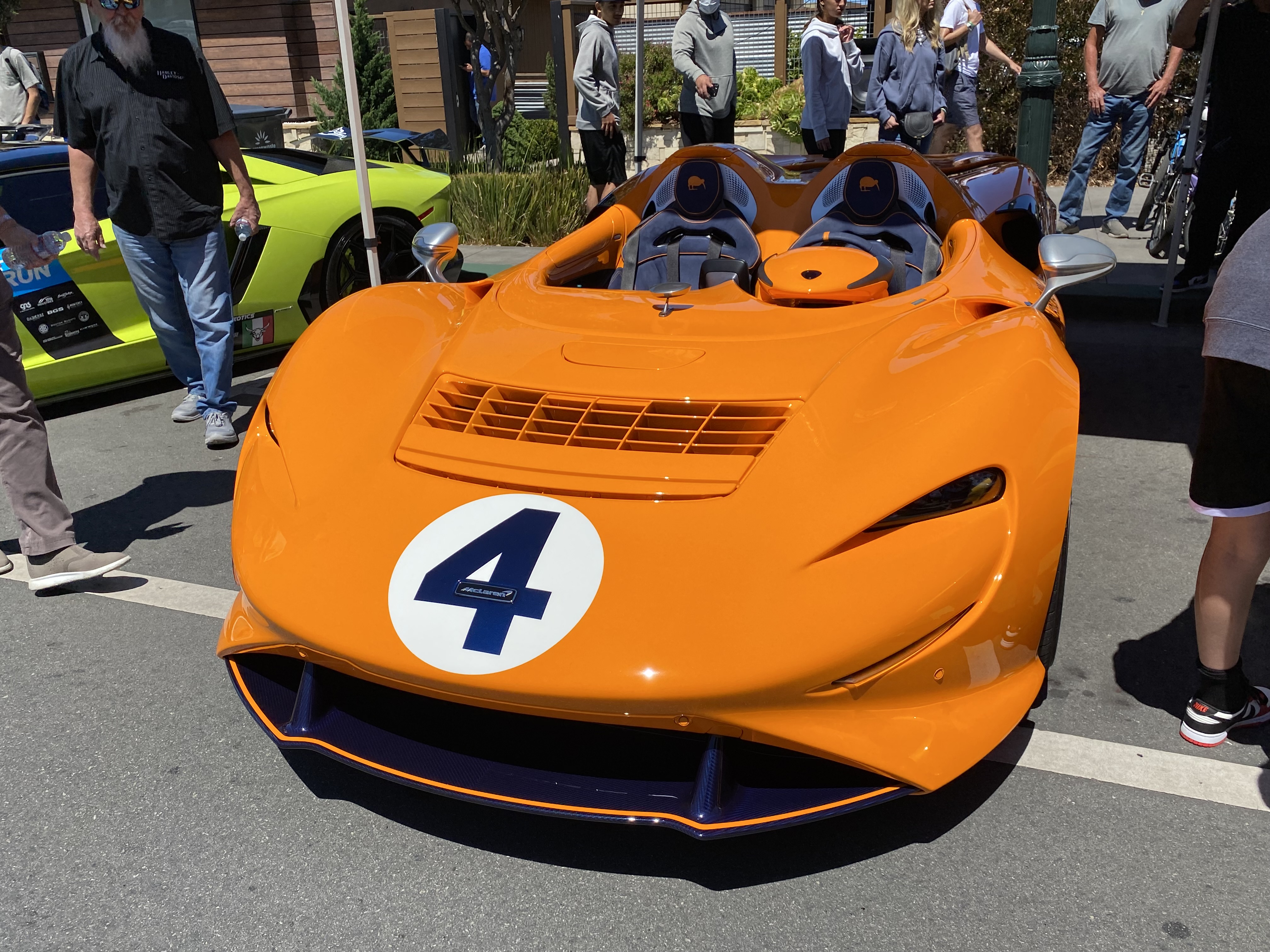
McLaren Elva


The Elva is one of many recent special McLaren models, but it is unique in it being a speedster with no windshield, roof, or windows. It was unveiled in Dubai in 2019 and produced for the 2021 model year. Powering the Elva is a 4.0-liter twin-turbo V8 producing 804 horsepower and 590 lb-ft of torque paired to a seven-speed twin-clutch automatic transmission. It launches from zero to 60 mph in 2.8 seconds and can reach a top speed of 203 mph. Its name is derived from a French term meaning "she goes," and its design is inspired by McLaren's open-air race cars from the 60s. The Elva is also the lightest McLaren production vehicle ever produced, weighing in at around 2,900 pounds, which shouldn't come as much of a surprise. It shares its carbon fiber tub and chassis with other McLaren models such as the 720S and Senna. Inside, the Elva's seats are made of Ultrafabric, a synthetic form of leather, and the other interior trim pieces consist of aluminum and carbon fiber. Although it is more stripped down than other McLaren models for a more pure driving experience, it still offers basic creature comforts such as air conditioning, heating, and navigation. A windscreen can be installed on the Elva as an option if the owner wishes to have one installed. 

Only 399 examples of the McLaren Elva will ever be made, with each one starting at $1.695 million. Like with some vehicles I recently featured on this site and some I plan to feature soon, this year's Exotics on Broadway in Monterey back in late August marked the first time I saw a McLaren Elva up close. Overall, the Elva is an amazing, stunning, and impressive supercar that may not be very practical but would be a ton of fun to drive.

Happy Halloween!

Buy CPF Merch (sample pictured below): CPF Store


Tuesday, October 25, 2022

Corvette C7 ZR1


The ZR1 is the top-of-the-line, most extreme version of the previous C7 Corvette. It first made its debut at the 2017 Dubai Motor Show for the 2019 model year, and it still remains the fastest, most powerful Corvette ever built. Powering the C7 ZR1 is a 6.2-liter supercharged LT5 V8 producing 755 horsepower and 715 lb-ft of torque mated to either a 7-speed manual or a 8-speed automatic transmission. This also makes the C7 ZR1 the last Corvette to offer a front-engine setup and a stick shift. It launches from zero to 60 mph in three seconds and can reach a top speed of 212 mph. Besides the badging, setting the ZR1 apart from lesser C7 Vettes are a restyled front grille, large hood vents and scoops, a more prominent carbon fiber front splitter, unique alloy wheels, and a large adjustable rear wing. It can also be fitted with a smaller rear wing as well. Its interior is pretty much the same as other C7 Corvette models, except with additional carbon fiber trim. 

Values for the C7 Corvette ZR1 vary, but they tend to range anywhere from $150k up to $300k. I anticipate that there will be a Corvette C8 ZR1 in the near future; it is probably at least a year or two away from hitting production and may have a hybrid powertrain. I first featured the Corvette C7 ZR1 on this site over three years ago, and after seeing two additional examples in person much more recently, I had to create another post on this specific version of the previous generation of Corvette. I see way less ZR1s than other Corvette models, and this especially applies to the C7. Overall, the C7 ZR1 is one of the absolute coolest and greatest Corvette models in existence. Its more aggressive styling, untamed nature, and sheer exclusivity make the most recent ZR1 a truly special and amazing vehicle.


Buy CPF Merch (sample pictured below): CPF Store