Tuesday, July 12, 2022

Lamborghini Huracan STO


The STO (Super Trofeo Omologato) is the most extreme version of the Lamborghini Huracan to date and is essentially a road-going Huracan Super Trofeo race car. It debuted for the 2021 model year as the replacement for the Performante in the vast range of Huracan models. The Huracan STO is powered by the same 5.2-liter V10 as the rest of the Huracan lineup, except tuned to 631 horsepower and 417 lb-ft of torque. Power is distributed to the rear wheels via a 7-speed dual-clutch. It launches from zero to 60 mph in 2.6 seconds and can hit a top speed of 193 mph. The STO stands out pretty well compared to other Huracan models with a restyled front fascia, additional vents, wider fender flares, large rear wing, and large scoop over the engine cover. It is constructed of mainly carbon-fiber-reinforced plastic for its body panels, while its interior is adorned in primarily a fabric made from carbon fiber known as "Carbon Skin." All these measures are intended to improve aerodynamics and conserve as much weight as possible for optimal straight-line and track performance. 

Pricing for the Lamborghini Huracan STO starts at $327,838. In addition, Lamborghini introduced the Technica as the latest version of the Huracan earlier this year, which slots in between the Evo and the STO in the Huracan lineup. Overall, the STO is an absolutely marvelous and bonkers supercar. I've been looking forward to seeing an STO up close ever since it was first announced, and I finally had the chance to do so at my local Cars & Coffee about two months ago. I was mesmerized by my first-ever Huracan STO sighting, especially when grouped together with other rare supercars on display there that are in a league of their own compared to all other vehicles near them. 

 Get your CPF Merch here: CPF Store


Saturday, July 9, 2022

Ferrari SF90 Spider


The SF90 is Ferrari's current and latest flagship supercar. It was first released for the 2020 model year, with the Spider version following suit in 2021. Ferrari has slotted the SF90 in its "mainstream" lineup just below the ultimate Prancing Horses (288 GTO, F40, F50, Enzo, LaFerrari) relative to other model series in its portfolio. Powering the SF90 is a 4.0-liter twin-turbo V8 mated to three electric motors producing a combined 986 horsepower and 590 lb-ft of torque mated to an eight-speed automatic. These help launch the vehicle from zero to 60 mph in 2.5 seconds and top out at 211 mph. The SF90 contains four different drive modes to select from: EV Only, Hybrid, Performance, and Qualify. Qualify mode allows the driver to fully reach the vehicle's performance potential. While in EV Only mode, the SF90 can travel up to 16 miles before its V8 kicks in. 

Like with its exterior, the SF90's interior is beautifully crafted and designed. It contains an LCD monitor, a six-speed sound system, and basic tech features. As with many supercars, the SF90 offers very little cargo space, but practicality isn't the SF90's intended purpose. Pricing for the Ferrari SF90 starts at $511,295 for the fixed-roof version, while the Spider starts at around $560,000. Overall, the SF90 is an amazing and incredible car. I was thrilled to see one in person for the first time at my local Cars and Coffee two months ago, and although it wasn't as polarizing as the F40 and Bugatti Veyron from the previous two posts, it was easily one of the coolest cars on display there that morning. The fact that I hadn't seen one up close before that show along with its unexpected nature made my first-ever SF90 sighting even more special.

Get your CPF Merch here: CPF Store


Sunday, July 3, 2022

Bugatti Veyron 16.4


Like the F40 in the previous post, this was an unexpected find at my local Cars & Coffee last month, and it completely blew me away when I saw it up close. This is the original Bugatti Veyron, and it is the first Bugatti model produced after the French boutique exotic car brand was acquired by Volkswagen in 2003. It is also the first well-known Bugatti model that even non-car enthusiasts became familiar with. The Veyron originally made its debut in 2006 and is powered by a 8.0-liter W16 churning out 987 horsepower and 922 lb-ft of torque. It launches from zero to 60 mph in 2.5 seconds and is capable of a top speed of 253 mph. A special top speed key must be entered into a specific spot to the left of the driver seat and activated in order to achieve its 253 mph top speed. Power is distributed to all four wheels via a seven-speed dual-clutch automated manual transmission. The Veyron has a retractable rear wing and spoiler that will automatically deploy when it reaches speeds of at least 137 mph. Its interior is quite lavish for a hypercar, adorned in leather and aluminum trim and features mainly analog gauges, clocks, buttons, and knobs for more of a timeless design and feel.

The Veyron is rarer than the F40 in the previous post, with 450 total units produced, 252 of which were the base 16.4 model. The rest of the Veyron's entire production run consisted of the open-top Grand Sport, even-higher-performance Super Sport, the Super Sport's open-top version, the Grand Sport Vitesse, and their various special editions. Production of all Veyron models ended in 2015 before getting replaced by the Chiron in 2016. The Veyron is also just as valuable, if not more valuable than the F40, currently valued in the $1-2 million range. I have only ever seen three Bugatti Veyrons in person, including the one featured here that I saw nearly two months ago, and pictures don't do them justice. The Veyron may not be the most beautiful or most intriguing hypercar, but it is absolutely breathtaking up close and has some insane performance figures. For many people, seeing a vehicle like the Bugatti Veyron or any other Bugatti model is a once-in-a-lifetime experience, so I would strongly recommend anyone do so if the opportunity arises. 

Happy 4th of July!

 Buy CPF Merch Here: CPF Store

Friday, July 1, 2022

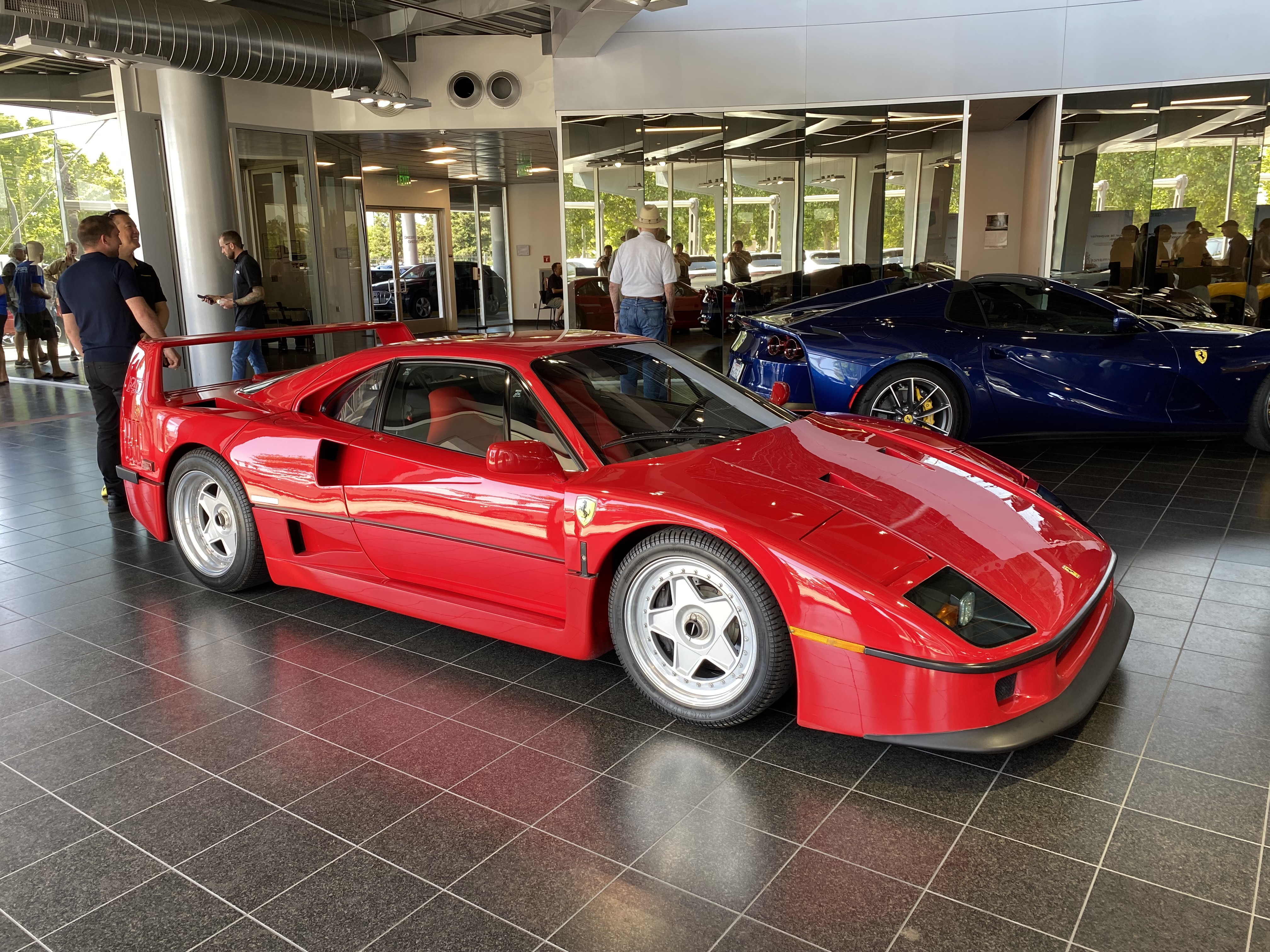
Ferrari F40


This is the first in a series of European exotic supercars that were on display at my local Cars & Coffee almost two months ago that I have been super excited and impatiently waiting to feature on Carson's Car Pics ever since I saw them up close. I'll first begin with the coolest, most famed, and most valuable vehicle on display there, the Ferrari F40. The F40 is second in the line of Ferrari's ultimate supercars, succeeding the 288 GTO and preceding the F50. It is also the model built to commemorate Ferrari's 40th anniversary and the last vehicle Enzo Ferrari planned before his passing. 

The F40 was produced from 1987 to 1992, powered by a 2.9-liter twin-turbo V8 with 471 horsepower and 426 lb-ft of torque mated to a five-speed dogleg manual gearbox. It launched from zero to 60 mph in around four seconds onto a 201 mph top speed. Every F40 was painted red from the factory, with at least a few examples repainted in different colors by aftermarket firms or for special orders. There is only one F40 logo on the exterior of the vehicle, located on the passenger side of the rear wing. It contains two sets of headlights, with the main ones being pop-ups located right above the fixed and most visible headlights. Unlike most conventional vehicles, the F40 contains center-lock wheels, which are typical of race cars. Another signature characteristic of the F40 is its lack of driver assistance features, creating one of the purest driving experiences of any Ferrari and any supercar for that matter. It features many aggressive air vents and is composed of a carbon fiber and kevlar mix, which was a first for Ferrari. The interior of the F40 is mostly spartan, with nearly every area of it stripped down to conserve weight. Ferrari has even gone as far as to remove the radio, climate controls, glove box, and cabin dome light to keep the F40's weight down. 

There are a few notable differences between the US-spec F40 and the Euro-spec F40, mainly the former having more pronounced bumpers, a third brake light, and automatic seat belts that move forward after getting in the car and opening/closing the doors. These changes were made to meet US safety regulations at the time, although the more pronounced bumpers don't look as good as the more regular bumpers on the Euro-spec model. In addition, the US-spec F40 has aluminum fuel tanks, while the Euro-spec F40 has fuel bladders that need to be replaced every 7-10 years. A total of 1,315 units of the F40 were made, which are the most out of any ultimate Ferrari in history, with pristine examples currently valued at north of $2 million. In all, the Ferrari F40 is one of the coolest and most magnificent vehicles of all-time. This was the first time I ever remember seeing an F40 up close, and I was completely blown away by how stunning and incredible this car is. The F40 is undoubtedly one of my top three absolute favorite Ferrari models ever produced and a truly one-of-a-kind vehicle.

 P.S. I recently launched my own merchandise store, go check it out: CPF Store